


In today’s volatile market, businesses that fail to adapt their strategies face significant financial and operational risks. According to a 2024 cross-industry survey, 90% of organizations struggle to pivot quickly in response to market changes, leaving them vulnerable to more agile competitors (Business Wire, 2024). This lack of adaptability often translates into lost market share, declining profitability, and a diminished brand reputation.
1. Market Share Erosion Is Inevitable
Research shows that companies unable to adapt to shifting consumer preferences, competitive dynamics, or macroeconomic changes tend to lose ground to more innovative rivals. When retailers and consumer goods companies fail to refresh their product mix, pricing, or channel strategy, they risk steady erosion of market share as competitors capitalize on emerging trends.
2. Revenue Loss Extends Beyond Top-Line Declines
Revenue drops are often accompanied by hidden costs. Customer acquisition expenses climb as loyalty weakens and businesses spend more to re-engage disengaged customers. Fixed operating costs remain constant even as revenue shrinks, which leads to compressed margins and declining profitability.
3. Strategic Goals Fail to Materialize
A “set-and-forget” strategy often decouples from execution over time. The 2024 Quantive Business Strategy Report found that organizations with continuously adaptive (or “always-on”) strategies achieved 68% of their strategic objectives, compared to only 59% for those that followed traditional static planning models (Business Wire, 2024). This performance gap represents wasted resources and missed opportunities.
4. Reputation and Brand Credibility Decline
Consumers increasingly expect brands to evolve in areas such as sustainability, customer experience, and social responsibility. Companies that fail to modernize risk losing premium positioning or being perceived as outdated. Rebuilding brand credibility after such decline often requires considerable time and investment.
5. Organizational Resistance and Change Fatigue
Resistance to change is common when strategies remain static for long periods. Frequent short-term tactical shifts without a unifying strategic direction can also create confusion. Harvard Division of Continuing Education’s change-management research highlights that failing to align strategy frameworks with real-world market signals erodes leadership credibility and undermines employee trust (Harvard DCE, 2023).
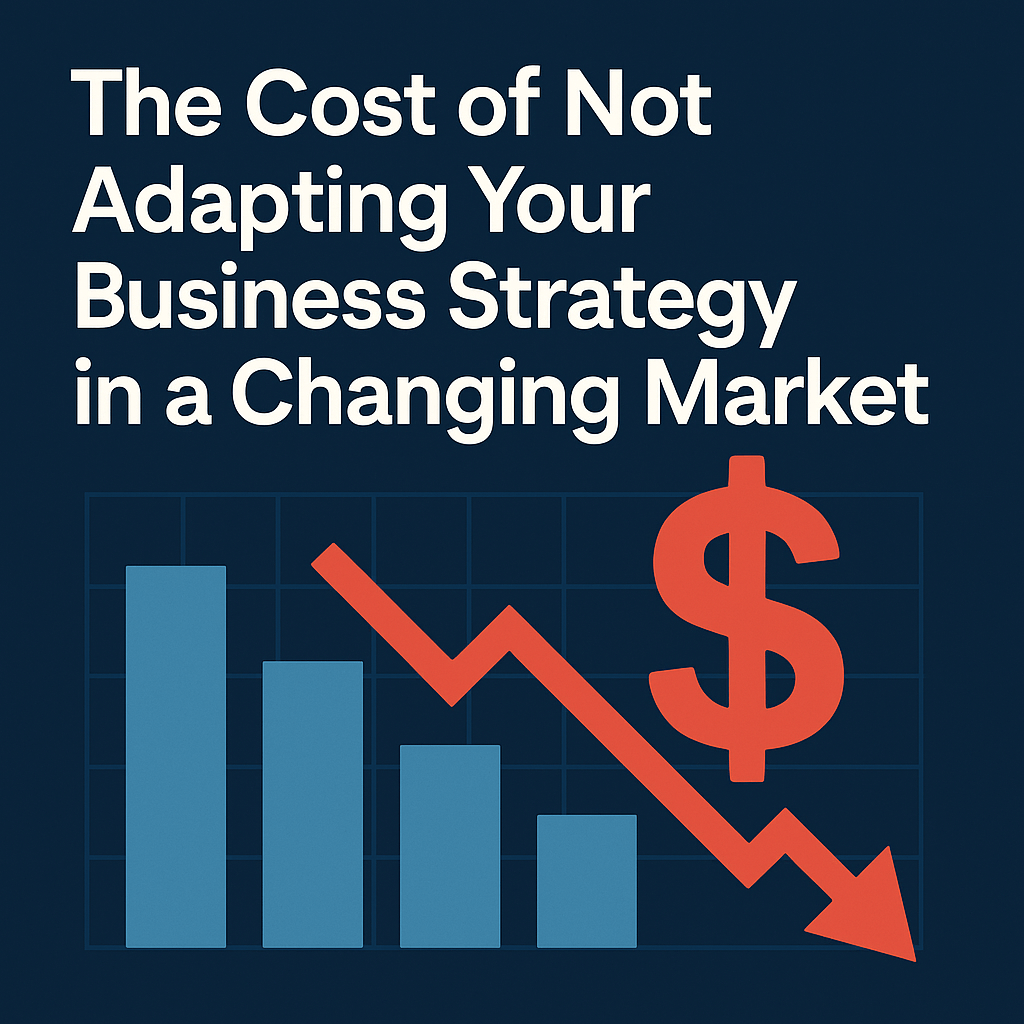
To avoid the pitfalls of strategic inertia, organizations should focus on market adaptability, competitive benchmarking, and data-driven decision-making rather than relying solely on short-term marketing trends.
A. Market Adaptability
B. Competitive Benchmarking
C. Data-Driven Decision-Making
At Caprisage Partners, we help retail and consumer goods businesses restructure their strategies to remain competitive in evolving markets. Our approach begins with a diagnostic review of outdated or brittle strategic processes. We then co-design a flexible roadmap that incorporates adaptability frameworks, competitive benchmarking practices, and data-driven systems to enable continuous course correction. The goal is not simply to weather market disruptions but to leverage them for growth.
Failing to adapt your business strategy to changing market conditions is an expensive risk that often results in lost customers, shrinking margins, and long-term strategic irrelevance. By prioritizing adaptability, competitive benchmarking, and data-driven decision-making, organizations can protect market share and position themselves for sustainable success. Are you ready to evolve your strategy before your competitors force you to?

Caprisage transformed our strategy with data-driven insights, improving efficiency and unlocking new growth opportunities across our global operations.

Their team combined strategy and execution perfectly, helping us streamline processes, cut costs, and accelerate digital transformation within months.
Caprisage transformed our strategy with data-driven insights, improving efficiency and unlocking new growth opportunities across our global operations.